Claudia works for GOPACS at EDSN as part of the team responsible for what are known as post-trading activities. These include the processes that take place after a transaction has been completed. Examples include processing redispatches and CSCs, publishing data on supply, and making the information required for financial settlement available. Claudia: “We ensure that, following a ‘trade’, the information ends up in the right place – for example, with market participants, system operators, BRPs and suppliers. Moreover, this field of activity is constantly expanding. It is therefore important that processes are well coordinated.”
Promoting the exchange of knowledge
As well as her work for GOPACS, Claudia is active within EDSN in the ‘community of practice’ for product owners. There, she seeks to encourage the exchange of knowledge between different sectors of the energy market. This combination fosters cross-fertilisation. In this way, Claudia aims to raise the profile of GOPACS’s working methods and culture within EDSN as well. “Congestion management is a relatively new field and is developing rapidly. At GOPACS, the lines of communication are short and we take a very practical approach. People readily take responsibility and feel free to speak their minds. I find that valuable to take with me to other places as well.”
Claudia has now been working at GOPACS for three years. During that time, she says she has seen the organisation grow to roughly three times its original size. That growth brings new challenges, but according to Claudia, one important aspect has remained intact. “What we’ve managed to preserve is the practical start-up mentality. People take responsibility, knowledge is widely shared and, despite the growth, the lines of communication have remained short. Almost everyone knows what’s going on within the organisation.”
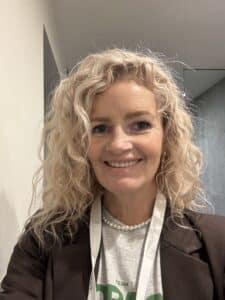
Who is Claudia Verhagen?
Claudia Verhagen is a Product Owner at EDSN/GOPACS and is involved in the development of market processes relating to congestion management and
redispatch. At EDSN, she works at the interface between the market, grid operation and IT, and is involved in the collaboration and technical integration between GOPACS and the
national grid operators.
A single centralised calculation for financial settlement
According to Claudia, GOPACS’s standing in the wider world has changed. Interest in flexibility and congestion management is growing, and with it the number of parties seeking to join the network. “GOPACS is increasingly seen as a train that parties want to hop on. We are now also in talks with new parties, such as charging operators and electric car manufacturers. That shows just how much momentum there is in the market.”
A key development Claudia and her team are currently working on is centralised financial settlement. According to Claudia, the first minimum viable product (MVP) is due to go live this quarter. “It’s been a long time coming, precisely because it involves money. We want to be able to calculate centrally what participants in congestion management are paid. This will ensure that participants from different system operators are subject to the same calculation method.” According to Claudia, the benefits of this include uniformity and efficiency. Every participating network operator can connect to the same solution. That foundation can then be further developed. For the time being, GOPACS is focusing on centralised calculation and information provision. Claudia sees opportunities to go a step further in the long term. “Ultimately, you could also look at centralised invoicing. But that’s really still a long way off.”
Two speeds within the same flexibility market
According to Claudia, when people talk about the flexible capacity market, they are actually dealing with two distinct worlds. On the one hand, there are the more traditional market players. They are entering the congestion market step by step and need stability, clear processes and sufficient time to implement changes. On the other hand, Claudia sees new, technology-driven players who, on the contrary, want things to happen much faster. “They’re more likely to say: give us an API and the data, and we’ll take it from there. They’re already working extensively with AI, for example, and are primarily interested in speed and access to raw data.”
For GOPACS, this means constantly navigating between these different needs. “One message from the market is: don’t do it too quickly. The other is: can’t it be done even faster? Both messages are important. We need to develop solutions that work for the market as it stands today, whilst at the same time leaving room for the market that is emerging.”
Meer ondernemerschap in congestiemanagement
If Claudia could accelerate one development, it would be greater entrepreneurship in the congestion market. “I would like to encourage far more parties to explore together what is needed. We are still shaping this market together. Nobody has all the answers yet.” In her view, this calls for a way of working together in which parties do not wait until every detail has been worked out in advance, but start, learn and improve together. As an example, she cites the development of the central financial settlement system, on which GOPACS is working iteratively with Enexis and TenneT.
“By starting together, you learn how processes and information flows work in practice. This enables you to respond more quickly to what is needed and to continue developing together.” It is precisely here that Claudia sees opportunities for the further development of flexibility. Too much time between an idea and its implementation can slow down innovation. In her view, experimenting within clear parameters can help us learn more quickly.
Designing together
Claudia’s key message to market players and network operators is not to wait until the market is fully developed, but rather to shape it together. “Let’s create the right conditions within which we can discover together how to make it work. Let’s not be afraid to do things simultaneously and learn from one another. We have a unique starting point here in the Netherlands. That also requires a certain amount of courage to create that market together,” says Claudia Verhagen.
“We’re all climbing the same ladder. If we do so in partnership and keep learning from one another, we’ll ultimately get further. Because unlocking flexibility requires courage.”
_
The People Behind GOPACS
In ‘The People Behind GOPACS’, we shine a spotlight on the professionals behind the platform. They share their views on developments in the congestion market and offer a unique insight into how GOPACS is contributing to a future-proof energy system.