Home
/
News
/
Customer story: from roof to data management; how DSG addresses congestion with solar energy
Customer story: from roof to data management; how DSG addresses congestion with solar energy
6 July 2026
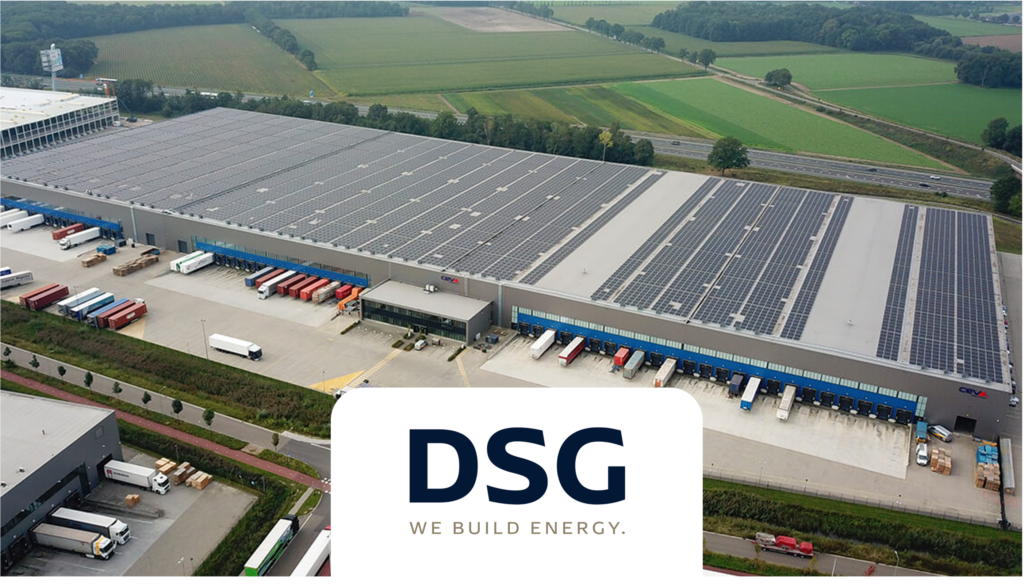
DSG operates large-scale rooftop solar installations throughout the Netherlands. With about 300 locations and an installed capacity of approximately 300 MWp, the company is one of the larger players in this segment. Its philosophy is clear: utilize unused rooftop space and make dual use of existing infrastructure. “We lease roofs from building owners, install solar panels on them, and handle all aspects of operations, including maintenance and service,” explains Martijn Vermeer, Chief Operating Officer. “In most cases, building owners benefit directly: they gain access to low-cost solar power and receive compensation for the use of their roof. In other cases, they receive only that compensation.” For about half of the installations, the energy generated is consumed directly on-site via the customer’s connection. The remaining installations are actively managed by DSG and sold on energy markets, including the congestion market.
DSG has been in operation since 2014, and the playing field has undergone major changes since then. “Whereas the focus was initially mainly on generation, we now see that active management is becoming essential,” says Vermeer. “Energy prices are under pressure, and grid congestion is hindering the further rollout of renewable energy. New connections or grid upgrades are often no longer a given.” This is precisely where DSG sees an important role for itself. The company manages its assets on a daily basis and deploys capacity where it is most valuable, for example on the balancing or congestion markets. “We are, in fact, our own business case,” says Vermeer. “We operate our systems ourselves and use our flexibility to create value.”
Via ETPA to GOPACS The move to GOPACS came via the ETPA trading platform. “Last year, we were introduced to GOPACS and made our first contacts. We then began the process of becoming a Congestion Service Provider (CSP), together with TenneT.” The technical connection has now been established, and DSG has started the onboarding process. “We’re already processing CBC calls via our API. That means we can automatically respond to congestion requests, for example by limiting feed-in from solar installations. We also receive compensation for this.” Although DSG does not yet provide redispatch services, the company is actively working on the necessary processes and qualifications. “There are still a few steps involved, particularly in qualifying EAN codes and setting up internal processes.”
Practical experience: collaboration and areas for improvement In its collaboration with grid operators, DSG has experienced a predominantly positive working relationship. “Signing our framework agreement with TenneT, Stedin, Alliander, and Enexis is a significant milestone. These parties have developed a great deal of expertise and are increasingly adept at managing congestion.” He is also satisfied with how the GOPACS platform operates, though there is still room for further development. “With GOPACS, you can work via a manual interface or an API, but sometimes there’s still a lack of insight. Think of information about call-offs or the status of the API.” According to Vermeer, there are also opportunities in the area of location insight. “It would be valuable to be able to see on a map where congestion areas are located and where your own assets are situated. That helps you act faster and more effectively.”
Martijn Vermeer from DSG
Scale and Geographical Distribution as an Opportunity With a portfolio of 300 installations, ranging from 100 kWp to 33 MWp, DSG has a broad and geographically dispersed network. It is precisely this geographical distribution that offers opportunities in congestion management. “Because our assets are located throughout the Netherlands, we can potentially help alleviate congestion in multiple locations,” says Vermeer. “The prerequisite, however, is that you have sufficient capacity and that the systems are properly connected to the market.” Current efforts are primarily focused on automated feed-in restrictions. In the future, DSG also expects to actively participate in other market mechanisms, such as redispatch.
Growth and Future Outlook DSG has grown significantly in recent years and now has about 35 employees. Vermeer joined the company in 2024: “Technology has always been my passion. The energy market—and specifically congestion—is incredibly dynamic and constantly evolving. There are many potential solutions, ranging from smart control to batteries. Despite the complexity, the barrier to entry into the congestion market is relatively low.” By making smart use of existing capacity and linking it to active market management, DSG contributes to a future-proof energy system and has a sustainable business model. Vermeer concludes: “Congestion management is commercially attractive and technically feasible. At the same time, we’ve noticed that some parties are still hesitant, but there’s no need to be. In fact, there’s still an opportunity: the market needs more flexibility, and more parties can contribute to that. And it also pays off.”